
Home › Patios & Walkways
Patios and walkways built for New England winters
Pavers, bluestone and natural stone, set on a base that won't heave after the first hard freeze. Call (000) 000-0000 or send the form for a free estimate. We'll review your request and help you with the next step.
- Free for homeowners
- Credentials checked before referral
- Pavers, bluestone, fieldstone
Request a Free Landscaping Estimate
Tell us about the patio or walkway. We'll review it and help you with the next step.
Please add your name, a 10-digit phone number and a valid email.
Sorry, we couldn't save your request just now. Please call (000) 000-0000 so it isn't lost.
We've received several requests from this connection in a short time. Please call (000) 000-0000 and we'll take it from there.
What it involves
A patio is only as good as what's under it
Most failed patios in this part of New England look the same: pavers that have heaved, sunk in the middle or spread at the edges. The cause is almost always below the surface. Frost pushes up whatever holds water, so a patio built on poorly drained soil or a thin base moves every winter.
A well-built paver or stone patio has the same layers whoever builds it:
- Excavation down through topsoil and organic material to firm subsoil.
- A compacted gravel base, laid and compacted in lifts rather than dumped in one pass. How deep depends on the soil and how much water it holds; clay and wet sites need more.
- Pitch away from the house so rain and meltwater don't run toward the foundation.
- A bedding layer of sand or fine stone the pavers are set into.
- Edge restraint to stop the outer pavers from creeping outward.
- Joint material, often polymeric sand, swept in and set.
When you compare estimates, ask each contractor how deep the base will be, what it's made of and how it will be compacted. A quote that's much cheaper than the others usually saves money there.
Materials
Choosing the surface
Concrete pavers
The most common choice. Consistent sizes and thicknesses, a wide range of colors and textures, and individual pavers can be lifted and reset if an area settles or a utility repair is needed.
Bluestone
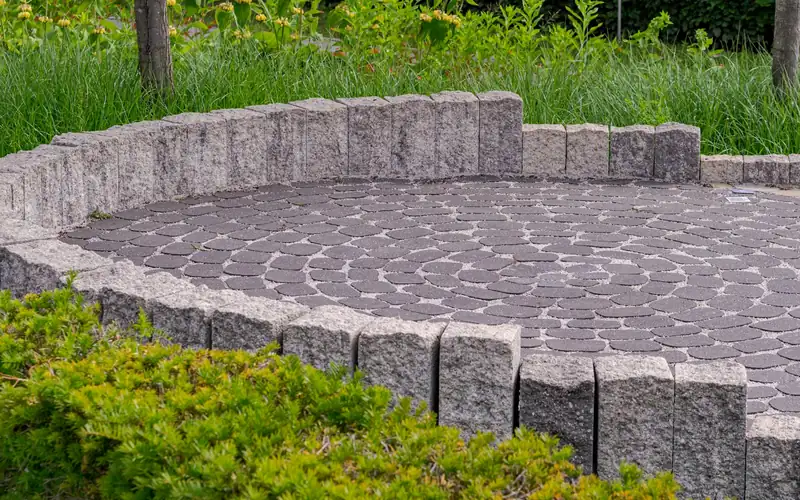
Dense, blue-gray sandstone that suits older New England houses. Set in stone dust for a dry-laid look or on concrete with mortar joints. Thermal finish gives better footing than a smooth honed face.
Natural fieldstone and flagstone
Irregular stone with an informal, settled look. More labor to fit, and the uneven surface suits garden paths and patios more than spots where you'll slide chairs.
Porcelain pavers
Thin, very hard and low-absorption, so they shrug off stains. They need a well-prepared base and careful cutting, and fewer installers work with them regularly.
Permeable pavers
Pavers with open joints over a clean-stone base that lets water soak in. Worth asking about where a town limits hard surfaces or a yard already has drainage trouble.
Walkways
Walkways and front entries
A front walk gets more foot traffic, more shoveling and more salt than a back patio. Wider is usually better: two people should be able to walk side by side to the door. Steps need consistent riser heights, and a walk that crosses a slope may need a few steps or a gentle switchback rather than one steep run.
If you use rock salt on a walkway, ask the contractor what the surface is rated for. Some stone and some concrete products handle de-icers better than others.
Massachusetts rules
Permits, registration and contracts
Building permit. The state guidance chart lists ground-level patios as needing no building permit. Electrical work for lighting or a gas line to a fire feature still needs its own permit.
Contractor registration. State regulations exempt contractors who work exclusively in landscaping and ground-level patios from Home Improvement Contractor registration. If your project mixes in a deck or a retaining wall, hire a registered contractor.
Contracts. Ground-level patios by a landscape-only contractor are exempt from registration, and the state home improvement contract rules may not apply. If the job includes covered work such as a retaining wall, contracts over $1,000 must be in writing and the deposit is capped at one-third unless special-order materials cost more. Either way, get it in writing.
Dig Safe. Excavation needs a Dig Safe notice (811) at least 72 hours ahead, not counting weekends and holidays. Property owners and contractors are both required to call, so agree in writing who places the ticket.
Wetlands and local rules. Within 100 feet of a wetland, pond or stream, check with the town's conservation commission first. Some towns also cap how much of a lot can be paved.
FAQ
Patio and walkway questions
Do I need a building permit for a patio in Massachusetts?
Usually not. The state guidance chart lists ground-level patios as needing no building permit, and the residential code exempts sidewalks and driveways. Raised decks are different and do need one. Local zoning and conservation rules can still apply, so check with the town if you're near a wetland or close to a lot line.
Does a patio contractor need a Home Improvement Contractor registration?
Not if they only do landscaping and ground-level patios. State regulations exempt contractors who work exclusively in those areas. A company that also builds decks or retaining walls should be registered, and only registered contractors' jobs are covered by the state Guaranty Fund.
Pavers or bluestone: which holds up better?
Both last when the base is right. Concrete pavers are uniform, come in many styles and are easy to lift and reset if something settles. Bluestone has a classic New England look but costs more and can be slippery when wet if it's honed rather than thermal-finished.
When is the best time to build a patio?
Spring through fall, once the ground has thawed and dried out. Winter is a good time to get the design and estimate done so you're on the schedule early.
Can a patio go near a wetland?
Sometimes, with approval. Under the state Wetlands Protection Act, work within 100 feet of a wetland generally goes to the local conservation commission first, and many towns have stricter bylaws. Each town page lists the local commission.
Other services